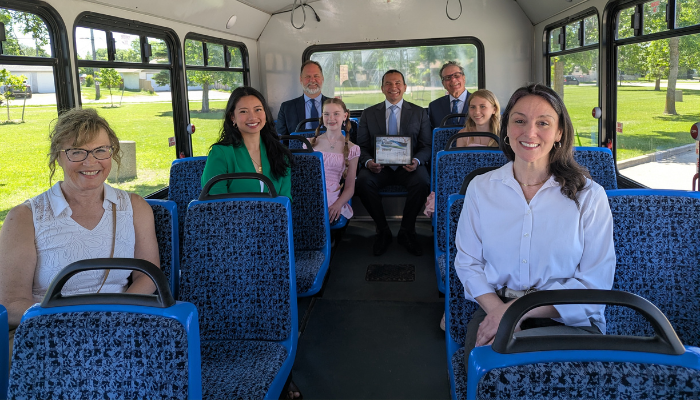
The City of Selkirk had been planning the launch of Youth Ride Free – a multi-year pilot program that would provide city youth with free rides on Selkirk Transit, with implementation identified in the city’s 2026 budget. The program is designed to remove barriers to mobility for young people, while improving affordability for families with children, promoting environmental sustainability, and supporting the city’s long-term growth.
Not long after the city’s budget announcement, the Province of Manitoba announced a complementary initiative in its March 24th budget, including that youth in Winnipeg, Selkirk and three other municipalities would ride Transit for free. The province has committed approximately $10 million to support the program. With the support of the province, Selkirk will be expanding its program to provide service to youth from the surrounding municipalities as well.
NextStop: Free Transit for Youth
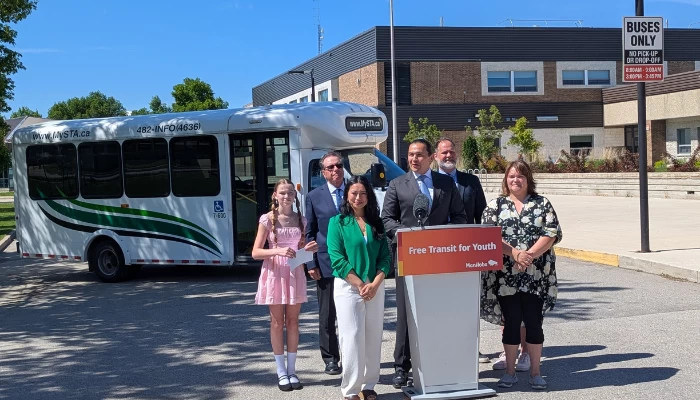
On June 16, Premier Wab Kinew, alongside Mayor Johannson, Selkirk Council, and Selkirk Transit representatives, announced “NextStop” — Selkirk’s free youth transit pass — at Lord Selkirk Regional Comprehensive Secondary School. The program will provide free transit for students aged 12–21, supporting Selkirk youth as well as students from neighbouring communities who attend school in the city.
The NextStop program began operating on Monday, June 15.
“We thank Premier Kinew’s Government for their investment in Selkirk and for aligning with our vision of making Transit more accessible for youth and more affordable for families. This commitment will help over 1,700 students from the Tri-S region of Selkirk, St. Andrews, and St. Clements get to school, work, recreation, and opportunities that they may not otherwise be able to reach.
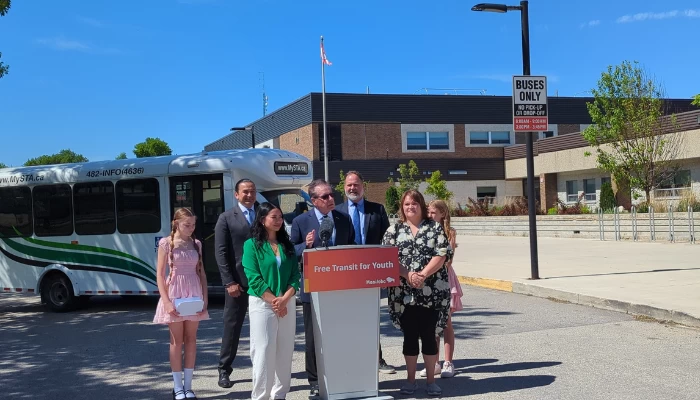
By making transit easy and accessible at an early age, we’re helping young people build their confidence and independence while creating lifelong habits where public transit is seen as a natural, reliable way to get around. Next stop: opportunity,” said Mayor Larry Johannson.
Other Canadian cities have seen significant ridership growth from free youth transit, along with wide-ranging benefits.
Shaping the future of Selkirk
Selkirk CAO Duane Nicol says the same potential exists here.
“Public transit is a vital service for a growing city. As Selkirk’s population continues to grow, it only makes sense that transit and thoughtful community planning go hand in hand.”
“In fact, there’s a strong case that transit has already contributed to that growth. When Seymour Pacific, our first major multi-family developer came to Selkirk, one of their first questions was whether we had transit.”
“We’re evolving alongside our transit system and in many ways, transit is helping shape the future of our city.”
Passes are available at the high school as well as the junior high. Outside of school, passes can be obtained from the city’s civic office with ID or proof of enrollment. Unlike traditional passes, the NextStop pass is not available on the bus.
Removing one of the biggest hurdles to attending school
Jerret Long, Superintendent of the Lord Selkirk School Division, is “super excited” with the city’s and province’s move to free youth passes.
“We think it’s fantastic to offer this opportunity for kids to access our schools and from our perspective it eliminates at least one of the barriers to kids getting to school and it helps with one of our biggest hurdles or concerns, which is school attendance,” Long said.
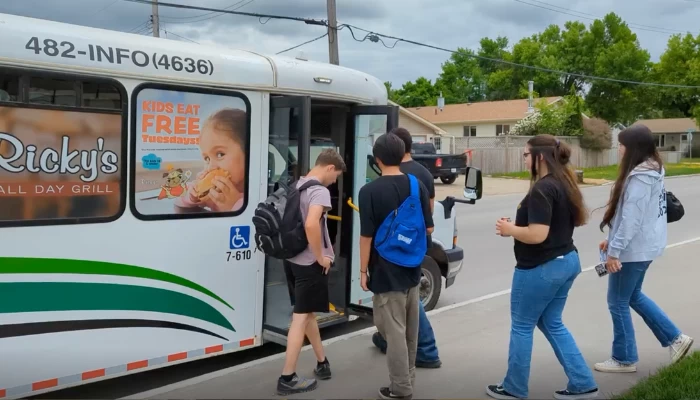
“That’s our No. 1 priority. We know that our staff can do great things in the schools with the kids, but they’ve got to be there. For us, it’s the actual access to the building for school and for academics. We’re happy about the other aspects, getting to extracurricular, but for us, accessing school can be a bit of a barrier too. Transportation is a huge piece so this support for our students, we don’t take it for granted.”
Ridership of Selkirk Transit has steadily increased over the years, going from 13,502 riders in Year 1, 2011, to 35,642 riders in 2024. The price has remained at a toonie a ride since inception, the one-hour route has largely remained the same with evening service, as well as a stop at Canadian Tire, added last year.
Increasing transit ridership is the goal, and getting young people on board is proving to be critical to achieving it.
Education key to increasing ridership
Along with free passes will come education on how to ride the bus. While at first blush it might seem that hopping on and off doesn’t require much know how, but the reality is, it can be intimidating and if you’re not confident, especially at a young age, you’ll let the bus pass you by.
Selkirk’s Youth Ride Free program, like most others in Canada, is modelled after Kingston, Ontario’s free youth program, the gold standard of kids riding the bus.
“Providing youth with free passes gives them the experience and comfort with using transit and it builds that future ridership,” Nicol said.
Modelled after Canada’s gold standard
It did in Kingston. Started in 2012 – not by a city employee or a transit employee, but a school district employee – Kingston’s free ride offering was at first just for Grade 9 students. In that initial year, ridership jumped by 28,000 rides.
Each subsequent year they added one grade up until they hit Grade 12. That year, ridership increased by 600,000 rides.
The employee who got the bus program rolling was Dan Hendry with the Limestone District School Board. His goal was to change a car culture to a transit culture.
Creating lifelong habits
“Ultimately the underlying philosophy of this program is with a bus pass in hand, mastery of transit tools, understanding of the system, students will gain independence and confidence, and they’ll use the bus now, locally, and in the future no matter where their life might take them,” Hendry said during a TEDx presentation in Ottawa in 2018.
Each year since the program’s inception, they take a bus to every high school in Kingston and educate the kids on everything to do with riding the bus, including putting your bike on the bus’s bike rack.
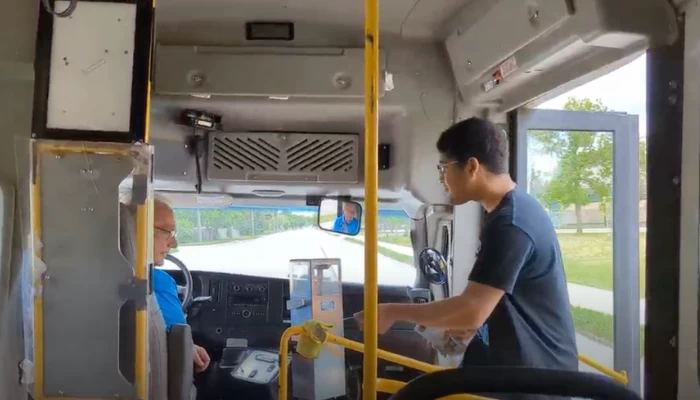
Hendry is now the Co-Founder and Program Director of Get on the Bus, a movement dedicated to supporting and connecting Canadian cities that want to get more youth riding their buses.
Hendry tells the story of his 30-year-old self, attempting to put his bike on the bus rack for the first time, and it ending with him turning red, sweating and being embarrassed as he tried to figure it out in front of dozens of strangers.
“It was intimidating even as a 30-year-old,” he said.
Now, during the yearly orientation sessions, each student is also given their free pass.
Youth transit is the route to long-term transit
“Nobody was teaching them how to use transit, nobody was teaching them the social, environmental, health or economic benefits, nobody was letting them meet the driver, nobody was showing them how to stop or get on and off the bus, but most importantly, nobody was highlighting the freedom they would have. And this is why we take a City of Kingston bus to every high school and we teach them first-hand about public transportation,” Hendry said.
“We regard the ability to use public transportation as an essential life skill.”
Selkirk is planning to follow that same route to success, bringing a bus to city schools each year to educate students and give them the confidence they need to get on the bus.
Nicol says if families don’t use the bus, the tradition continues, and kids won’t either. Educating kids at school about the many benefits of using the bus is aimed at giving them the chance to develop a new habit, that can continue over their lifetimes.
“It’s generational, if you didn’t grow up using transit with your family you don’t really know how it works, it’s kind of scary and different and you just fall into the pattern of behaviour from the culture you’re in. You learn to drive everywhere because that’s what seems normal,” Nicol said.
“It can take generations before taking transit becomes a natural choice for people and by offering Youth Ride Free, we’re sort of short circuiting that adoption curve and hopefully getting young people on the bus right away so they can grow up with transit and they can pass it on to their children.”
Selkirk is a growing city that is recognized as a leader in climate change mitigation. Getting bus ridership up will help reduce vehicle emissions with fewer trips taken in cars which will lower greenhouse gas emissions and extend the life of road infrastructure. It will also help lower the city’s carbon footprint, reduce traffic congestion and support the city’s broader goals related to climate action and environmental stewardship.